
 Maintaining a comfortable and energy-efficient space includes selecting the right garage door insulation. As you compare garage doors, you'll likely come across terms like U-value, U-factor, and R-value. But what do these ratings mean, and how do they impact your garage's temperature, energy use and overall comfort? This guide explains how these measurements work, helping you make the best choice for your home or business.
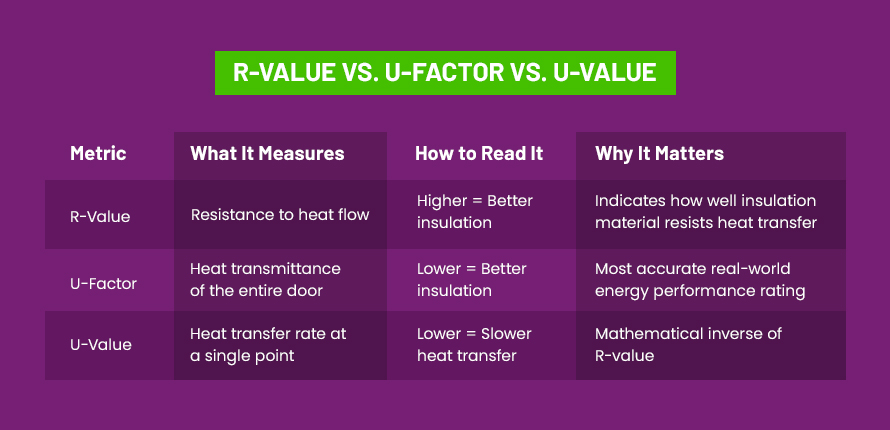
R-value is a measurement of how well insulation resists heat flow. In garage doors, a higher R-value means the door does a better job trapping heat inside during winter and keeping heat out during summer.
U-factor measures the rate at which heat passes through garage doors. The lower the U-factor, the better the insulation because it indicates that less heat is able to escape, making a space more energy-efficient.
U-value is another rating that focuses on heat transmittance. While R-value measures resistance to heat flow, U-value measures how quickly heat is transferred through the door.
U-factor and U-value are often used interchangeably, but they are not the same. U-value is technically the inverse of R-value, which means it calculates the same measurement but expressed differently. The U-value calculates the thermal resistance at a single point on the garage door, whereas the U-factor takes the heat transmittance of the entire door into account.
When looking for garage doors, you'll see both R-value and U-factor listed as indicators of energy efficiency. However, these numbers work differently, which can be confusing if you're not familiar with insulation terms.
Garage door U-factor measures heat transmittance, while R-value focuses on heat resistance. Another notable difference between these ratings is how they are calculated. To calculate the R-value of garage door insulation, manufacturers only focus on a single component and not the entire door, which can be misleading if you want to know how the whole door will perform.
U-factor is a broader measurement. It is determined through third-party testing and verification, as per ANSI/DASMA 105, by the Door & Access Systems Manufacturers Association (DASMA). This rating accounts for the entire garage door assembly, including panels, joints, seals, windows, and hardware. U-factor provides a more accurate measure of the door's real-world energy performance, as it includes all components.
The type of garage door insulation used has a significant impact on its insulation rating. The two main types are polystyrene and polyurethane insulation:
Polystyrene is a rigid foam panel that's cut to fit inside a garage door's frame. It provides a decent increase in R-value, usually with a rating between R2 and R10. This insulation is more affordable than other options. However, because it's installed in sections rather than bonded to the door, it may leave some air gaps.
Polyurethane is a spray foam that expands and bonds to the inside of the door panels. This process creates a denser, more rigid structure that improves both the R-value and the door's overall strength. It usually has an R-value rating between R10 and R17.5. Polyurethane-insulated doors typically offer better energy efficiency and noise reduction compared to polystyrene.
Investing in insulation offers many benefits that go beyond just keeping your garage warmer in the winter. Here's why your garage door should be insulated:
Beyond comparing ratings and numbers, selecting the right garage door also means finding a suitable fit for your climate, property and lifestyle. Here's what to keep in mind while you shop:
Depending on where you live, you may be familiar with frigid winters and fluctuating temperatures. If you want to keep your home or business comfortable year-round, it's crucial to prioritize a garage door with strong insulating properties. Look for lower U-factor ratings and higher R-values to help winterize your garage door and make a noticeable difference during harsh weather.
Consider how you use your garage door to determine the level of insulation you need. If you use your garage door to park your car, moderate insulation would be sufficient. However, if you use the space for work while living in a region with extreme temperatures, higher insulation is the best solution.
Not all insulated garage doors are created equal. Materials such as polyurethane and polystyrene offer distinct benefits and insulation performance. On the other hand, multilayer steel or aluminum doors can provide better performance and durability compared to other options. It's essential to evaluate various options and select the highest-quality door construction.
Your garage door should complement your property's architecture while meeting your functional needs. Explore premium brands like Clopay to ensure you get the best of both worlds. You should also speak to garage door experts so they can guide you through style, window and decorative options.

Understanding U-factor, R-value, and garage door insulation ratings is a great first step — but choosing the right garage door doesn't have to be complicated when you have a trusted local partner on your side.
At Ingstrup Garage Doors, we know every home is different. That's why our experienced team is here to answer your questions, explain the benefits of different insulation types and help you compare U-factor ratings based on your climate and lifestyle. We proudly feature high-quality Clopay garage doors and a range of engineered-to-order solutions, so you never have to settle for less than the perfect fit.
Ready to improve your comfort and efficiency? Contact our team or request service online today.


WE can’t wait to work with you!
Call us at (517) 305-8459 for an estimate or use our 24/7 scheduling widget to schedule an appointment today.
Michigan Builders License number: 2101194343